We can manage what we measure: where near-term reductions in methane are important and achievable
Today, United Nations Secretary General António Guterres released a powerful call to action, urging world leaders, businesses, and investors to come together to take concrete steps to tackle methane emissions.
As the report outlines, there are a number of opportunities to take action quickly, with proven methods that can be deployed at scale. Climate TRACE has not only documented many of these solutions, we have pinpointed hotspots where action to cut methane emission would have the greatest impact.
Climate TRACE’s Emissions Reduction Roadmap tool calculates the potential impact of implementing a wide range of solutions across all sectors and every asset in the Climate TRACE inventory. That includes top priorities in the Secretary-General’s report such as stopping non-emergency venting and flaring during oil and gas production, phasing out uncovered landfills, and adopting practices that reduce methane from livestock.
The tool allows anyone to see how a solution would cut emissions at whatever scale they choose – from global to hyper-local: in your country, your city, or at the local landfill.
Using data from this tool, our new white paper, We Can Manage What We Measure, looks at current methane emissions trends and opportunities for action in each of the three sectors prioritized in the Secretary-General’s report. Because the Climate TRACE inventory is both highly detailed at the facility level and covers nearly every major facility in the world, we provide new insight into where action can have the greatest impact.
As the Secretary-General’s report notes, mitigation actions in fossil fuel sectors are among the most proven and scalable solutions to methane emissions in the short term.
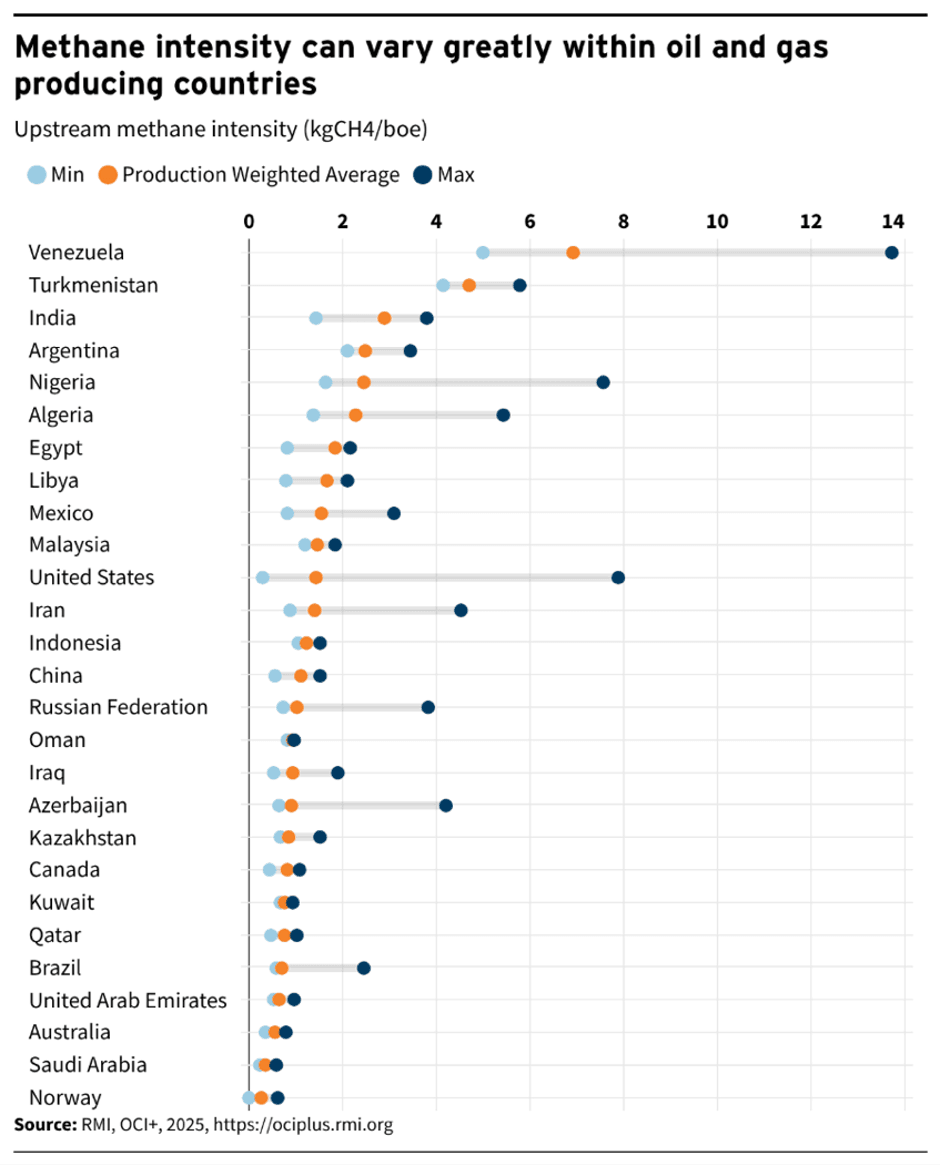 Upstream oil and gas methane intensity (kg CH₄ per barrel of oil equivalent) by country—minimum, production-weighted average, and maximum. Wide within-country ranges signal substantial technical and economic room for mitigation. Source: RMI, OCI+, 2025.
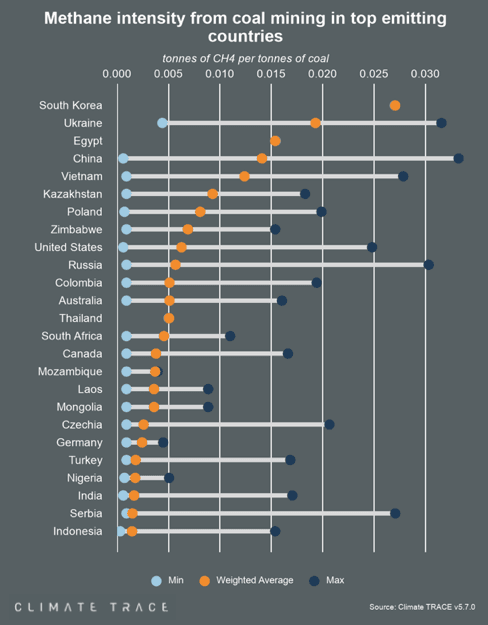 Methane intensity from coal mining (tonnes CH₄ per tonne of coal) in top emitting countries—minimum, weighted average, and maximum. Source: Climate TRACE (data version 5.7.0).
Many fossil fuel producing countries are home to oil and gas fields that have outsized climate impact due to how much methane escapes during production. But these countries also have facilities that are highly effective at limiting methane leakage. In places where operators already have expertise to prevent significant methane leakage, there is promise for future methane mitigation at assets within that country on the higher end.
Another example is in waste, where the outsized role of a small subset of the world’s landfills is striking. The top 10% of emitting landfills globally – 1,373 individual sites monitored by Climate TRACE – account for 70% of all methane emissions from waste.
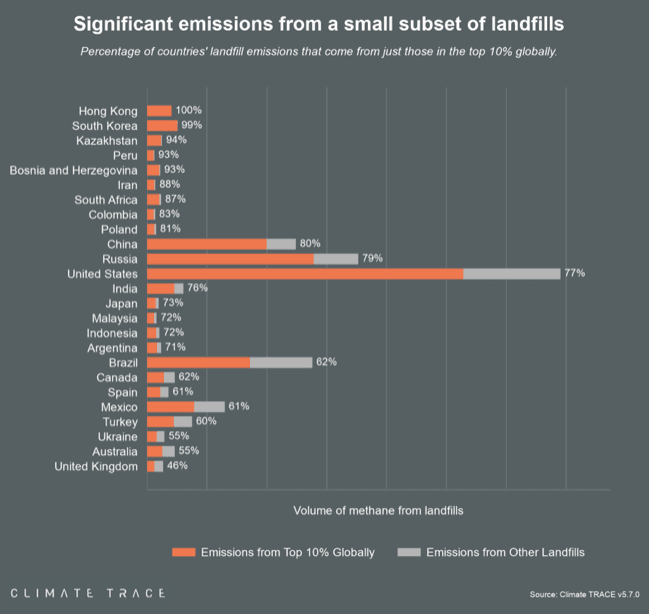 Share of each country’s landfill methane emissions coming from its top 10% of landfills. In many countries the highest-emitting sites account for the large majority of landfill methane. Source: Climate TRACE (data version 5.7.0).
As the axiom goes: “we can manage what we measure.” Methane may be invisible, but satellite instruments continue to launch, ground sensors continue to monitor, and analytic tools continue to be refined to make the invisible, visible. Knowing where, when, and how much methane escapes into the atmosphere from human activity enables action. By calculating how much methane is escaping into the atmosphere and identifying with precision where it’s coming from, we can better prioritize action in the short- and long-term.
Read the full white paper, We Can Manage What We Measure.
Image: "Methane Flare" by Carl Young, Wikimedia Commons, licensed under CC BY-SA 4.0.