Austria and France banned short-haul flights to boost train travel and reduce emissions. Did it work?
During the height of the COVID-19 pandemic, the interconnected web of global aviation quickly unraveled amidst widespread travel restrictions. Between April 2019 and April 2020, international and domestic passenger traffic plummeted by roughly 95%, grounded by a world in lockdown. In 2020 alone, airlines lost an estimated $372 billion in gross passenger operating revenues. But the skies didn't stay empty for long.
Air travel staged a bold comeback, ascending past pre-pandemic benchmarks by early 2025. Global air travel could reach almost 136% of its 2019 levels by 2030, according to Bain & Company forecasts.
Climate TRACE emissions estimates for domestic and international aviation mirror these passenger and economic trends. Aviation emissions for 2020 overall fell 49% vs. 2019 numbers; April emissions specifically plummeted 72% vs. the same month one year earlier. By the end of 2025, however, annual global aviation emissions reached new heights, surpassing 921 million tonnes CO2e.
Yet even as the global trend line points upward, a closer look at the data reveals another storyline --- about how two nations pioneered success stories of intentional, policy-driven aviation decarbonization. Enter: Austria and France.
Turning industry bailouts into climate mandates
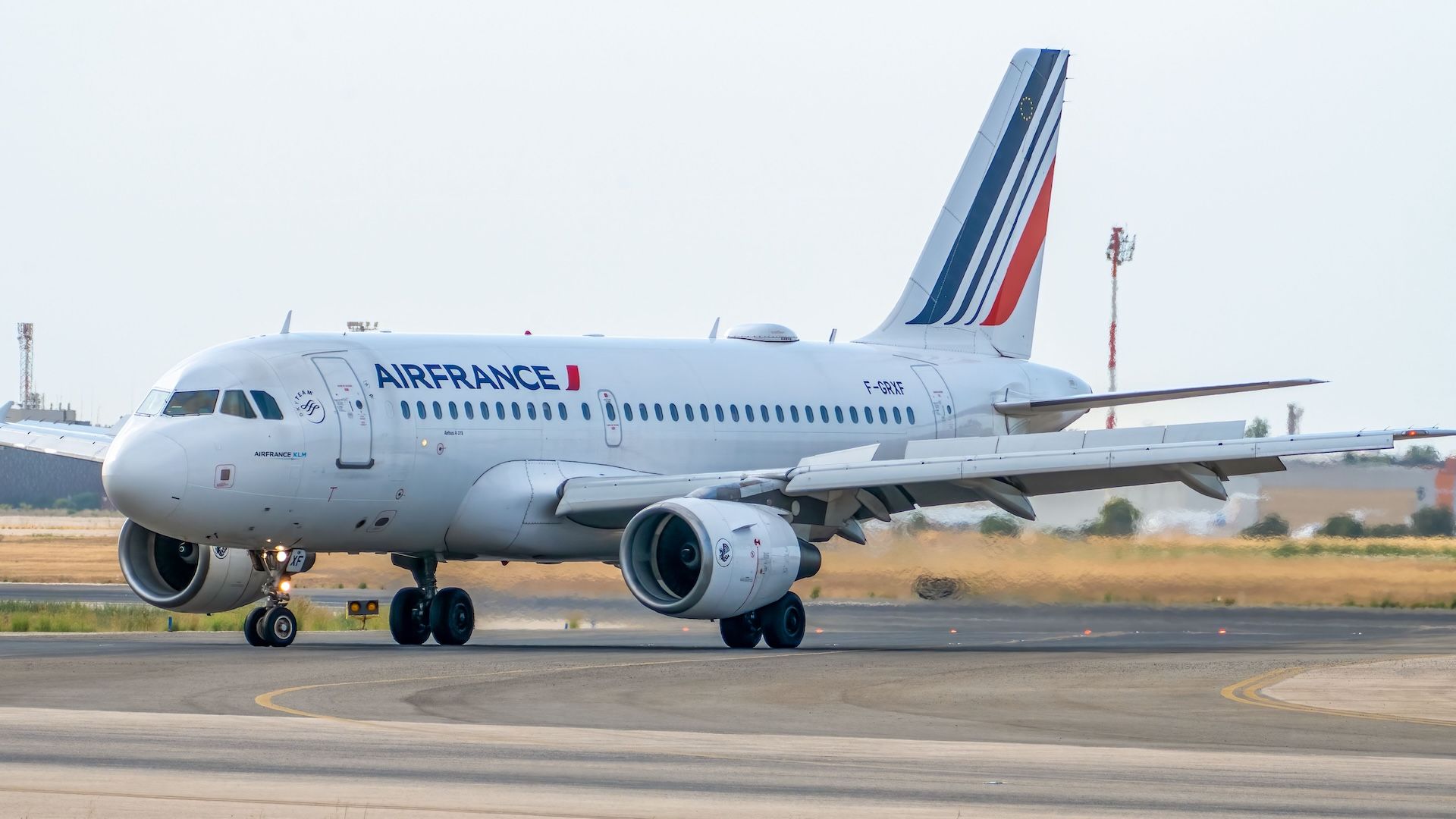
As the aviation industry confronted pandemic-inflicted financial woes, many governments offered bailouts to help their airlines recover. In Austria and France, those bailouts came with conditions for their flagship carriers, including ones central to those nations' climate targets: for Austrian Airlines and Air France to receive the funds needed to stay afloat, they had to abide by new emissions reductions requirements.
In Austria, a €450 million rescue package for Austrian Airlines was tied to a promise to slash domestic emissions 50% by 2030. France similarly offered Air France €7 billion of state aid, contingent on halving its domestic flight emissions even sooner, by 2024.
But exactly how would the airlines and the countries' aviation sector slash their domestic emissions? The answer was rail. In each case, the government put in place an outright or de facto ban on short-haul domestic flights where reasonable train service under certain travel times --- ranging from two and a half hours to three hours --- existed as a viable alternative.
The French government was the first to suggest this approach in mid-2020, followed by Austria a few weeks later. Austrian Airlines moved first, however, grounding flights under its de facto ban in July 2020. France later codified its proposed ban in its 2021 Climate and Resilience Law, and by May 2023, the ban went into effect with approval from the European Commission.
A few years later, the industry now has enough track record in Austria and France to take a first look: Would these policies work in practice, or would they be lost in the turbulence of a rebounding industry? Climate TRACE emissions data suggest the policies did, in fact, deliver their hoped-for emissions reductions.
The Austrian shift
Even before the pandemic, domestic aviation was a relatively small slice of Austria's total air travel emissions. That's partly because the country is relatively small: by land area, it's one-fourth the size of Germany, one-sixth the size of Spain, and one-seventh the size of France.
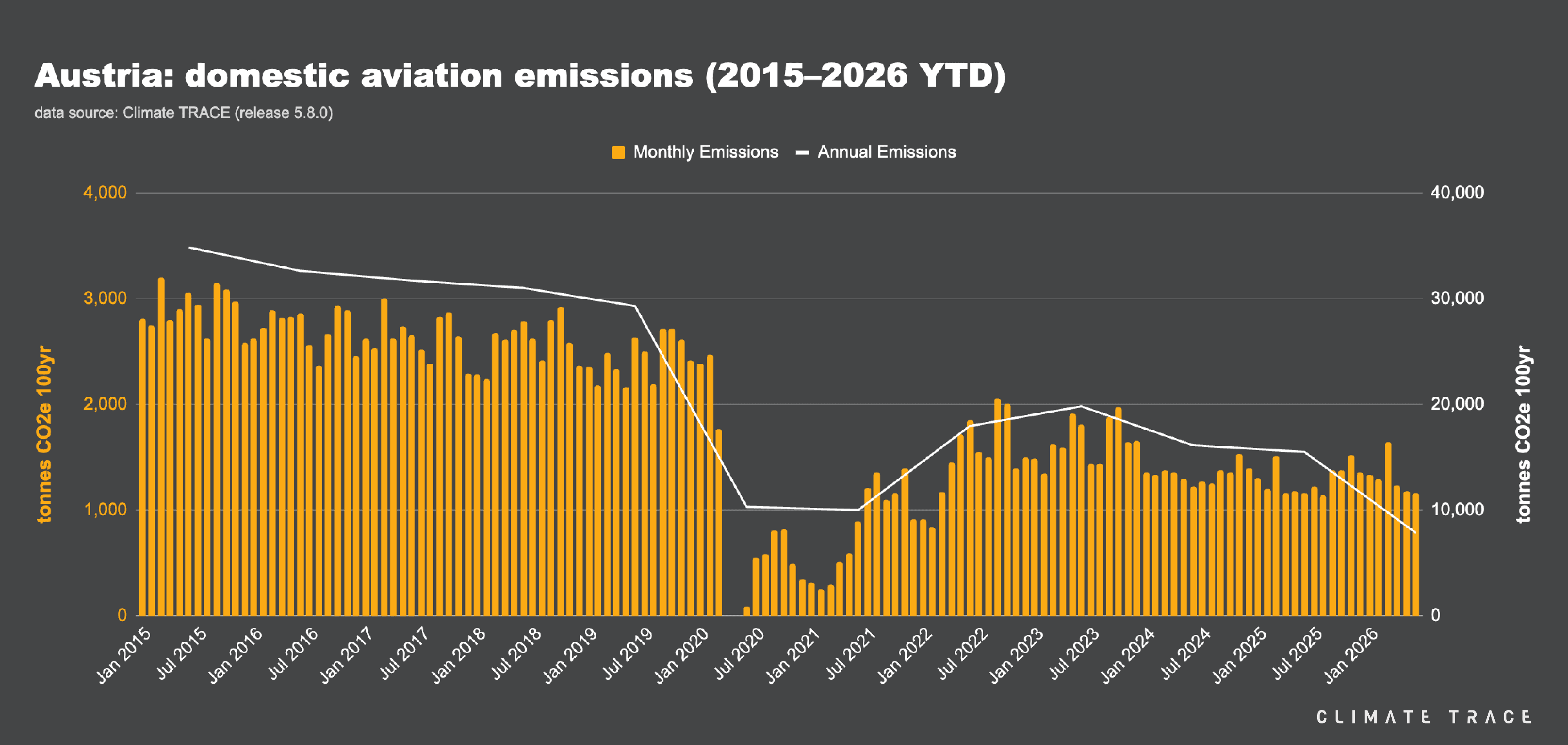
But since July 2020 --- when the country's de facto short-haul flight ban took effect --- that small slice of domestic aviation emissions has significantly shrunk further. Today, domestic aviation is the single least-emitting subsector within the entire Austrian transportation sector.
While the sector experienced a modest post-COVID bump in activity, Climate TRACE data show that the country's domestic aviation emissions have declined in each of the past three years, descending 22% during the period 2023 through 2025.
A similar pattern is seen specifically in the domestic cities most affected by the ban, including Vienna, Graz, and Salzburg. At Vienna International Airport and Graz Airport, domestic aviation emissions have fallen from their 2023 post-COVID peaks. Salzburg effectively no longer has domestic flights to and from Vienna and other cities in Austria.
France's success at Orly
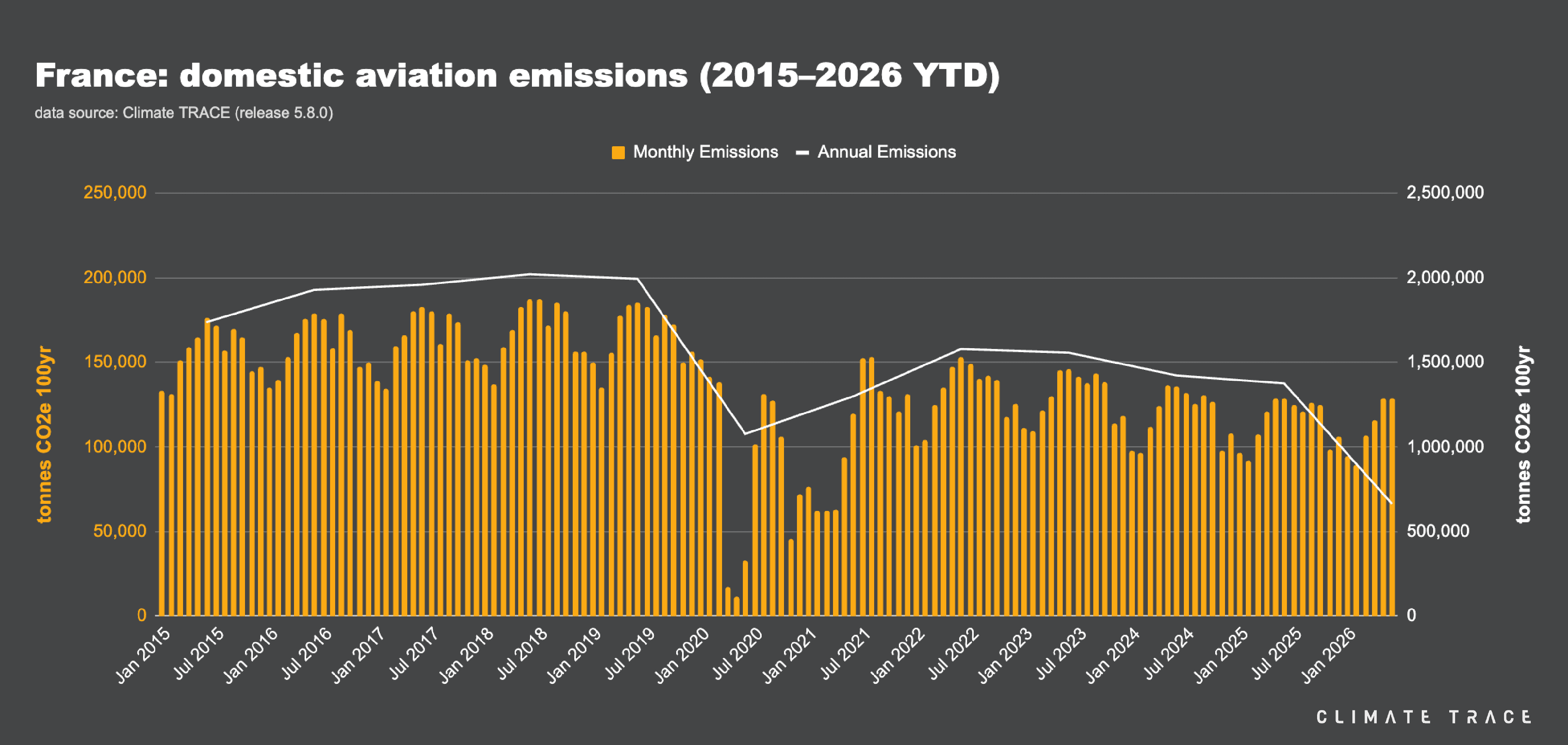
In France --- like in Austria --- domestic aviation has historically been a smaller contributor to the country's total air travel emissions, ranking as the third-lowest emitter in the French transportation sector, just ahead of railways. And also not unlike Austria, France's domestic aviation emissions experienced a slow and steady decline from May 2023 --- when the short-haul ban took effect --- to December 2025.
But in France, the ban was limited in scope. It ultimately centered on Paris's Orly airport and three particular routes to Bordeaux, Nantes, and Lyon. The ban was originally supposed to affect eight short-haul flights, but the European Commission only agreed to halt route routes between these three cities because they provided quick, easy rail alternatives with several direct connections each way, every day.
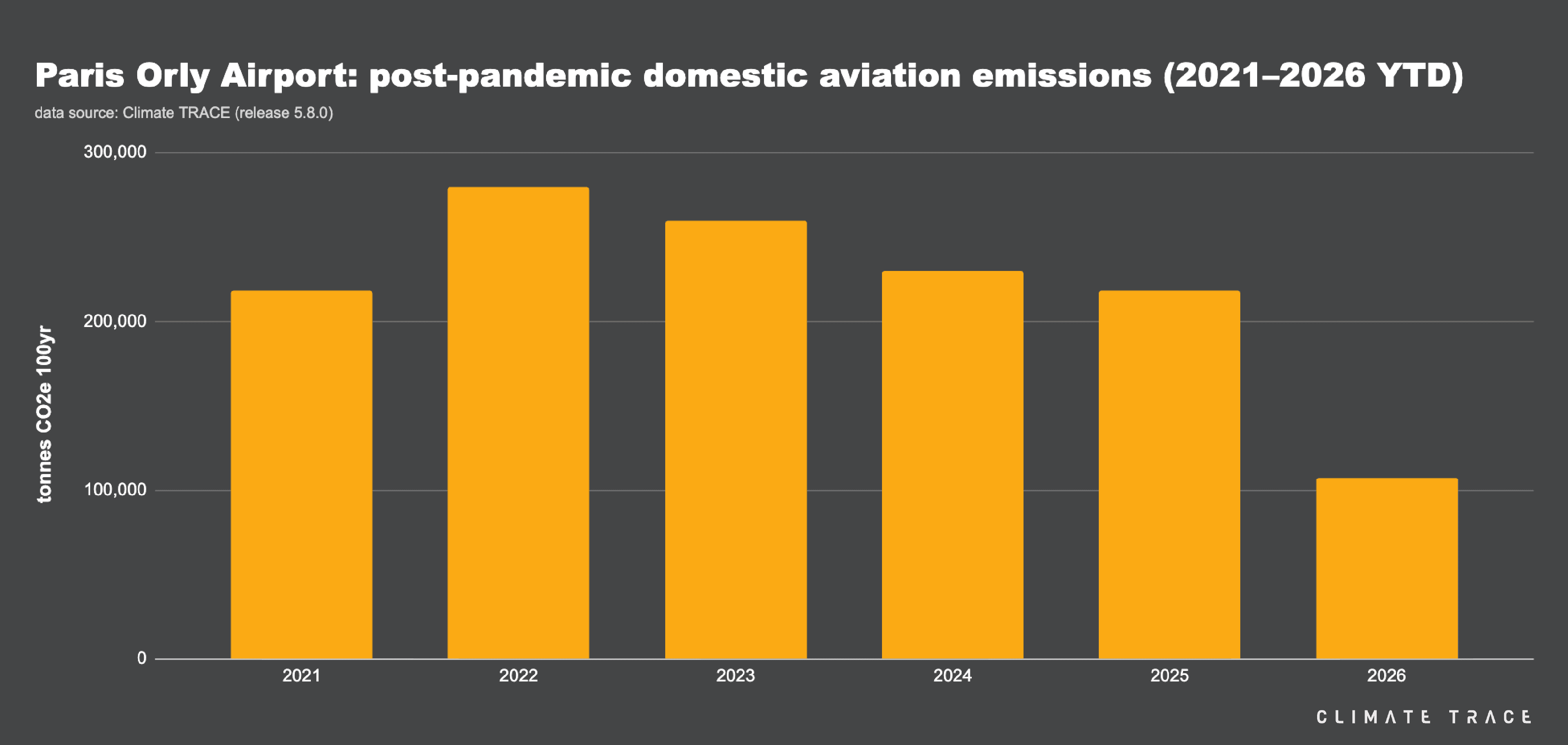
Emissions reductions at Orly mirror and outpace the rate of domestic aviation emissions reductions across France as a whole. Climate TRACE data show ongoing emissions declines for domestic aviation out of Orly that correlate with the implementation of the ban, shrinking 16% from 259 kilotonnes CO2e in 2023 to 218 kilotonnes in 2025. Domestic aviation emissions in Bordeaux, Nantes, and Lyon all followed suit in tandem, decreasing year after year since 2023.
The emissions reduction potential of a plane-to-train transition
These initial successes in Austria and France are promising.
They also prompt a number of follow-on questions: What might be the climate benefit if such policies were more broadly adopted across Europe? What if they were implemented beyond Europe’s borders? What if they were applied to short-haul international flights, and not merely domestic routes?
Moreover: Beyond short-haul bans via national policy and regulation, what might be the role of voluntary sector actions? And what about the climate side-effect of pure economic influences?
Transportation and climate researchers have been taking a closer look.

Research published in 2021 found that, in Finland, replacing all short-haul flights with non-high-speed rail could cut emissions by 95%. One year later in 2022, different researchers took a broader look at commercial passenger flights across 31 countries. A 2023 study took a closer look at Spain's two busiest domestic corridors: Madrid-Barcelona and Madrid-Valencia. In 2024, data from IATA focused a lens back on France. And more recently, a September 2025 study on commercial intra-European aviation concluded that substituting short-haul flights with rail alternatives could reduce a trip's emissions by up to 97%, depending on the length of the trip.
The potential emissions reductions are substantial, but several of the studies also arrived at additional conclusions: partial short-haul air travel bans could have some benefit, but broader implementation would be needed to make a larger dent in aviation emissions. Even moreso, addressing the large fuel consumption and associated emissions of long-haul flights also needs to be a priority.
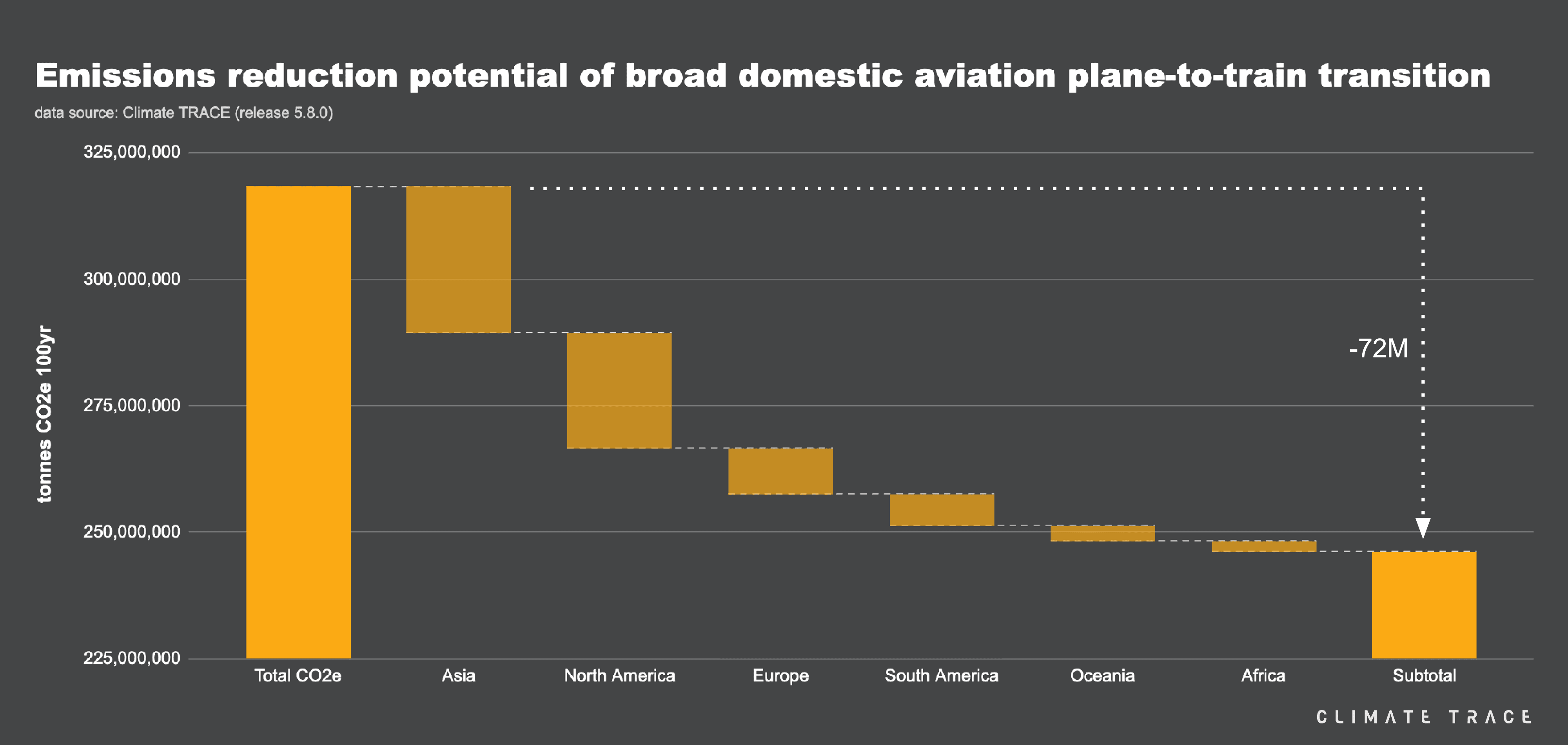
Climate TRACE software engineer and data scientist Ishan Saraswat ran the numbers, using coalition data. Broad adoption substituting rail service for domestic flights less than 500 miles (800 km) could slash 40% (nearly 9 million tonnes CO2e) of Europe's domestic aviation emissions. If adopted globally, that same policy could reduce more than 72 million tonnes of annual emissions. Expanding the policy to also include short-haul international flights reduces an additional 19+ million tonnes annually. Those 91 million tonnes are roughly equal to the entire economy-wide annual emissions of countries like Greece, Ecuador, New Zealand, or Portugal.

Charting the course ahead
In April earlier this year, German aviation giant Lufthansa announced the cancellation of 20,000 uneconomical short-haul flights through October, a move that would save the company an estimated 40,000 tonnes of jet fuel. Also in Germany, Lufthansa and other airlines have integrated their international ticketing with Deutsche Bahn, enabling passengers to seamlessly book rail interconnection to any of more than 5,000 train stations in the country.
But there are also signs of possible turbulence on the radar. In a move directly counter to the plane-to-train transition, in December 2025, media headlines broke the news that some airlines were actively competing with rail lines, looking to lure passengers away from trains like Eurostar by boosting flight frequencies on well-connected routes such as between London and Paris.
In Spain through the early 2020s, airlines maintained their flight frequency, even as high-speed rail started to gain traction in the country. More recently, air carriers are now even expanding capacity in a response to the nation's railway crisis and beleaguered passenger rail industry.
Nonetheless, some tracks have been laid. In the nearest term, oil price shocks are rippling through aviation and other sectors, adding further pressure to airlines' operations and financial bottom lines. It will take time for markets to smooth out. As they do, we can continue to watch the skies --- and the data --- to continue tracking progress toward the ultimate destination: a lower-carbon aviation future.
Thanks to Ting So and Lekha Sridhar, who also contributed perspective to this article.
Image credits: Austrian Airways (@suissounet / Pexels), Air France (@thales13 / Pexels), Frankfurt Flughafen (@leonardrichards / Pexels), London train station (@serge / Pexels).